Chinese Canned Food Suppliers With OEM and Private Label at Low MOQ: Criteria, Comparison, Buyer Guidance
2026-10-09T17:29:41+08:00
A screenable framework for importers and private-label brands comparing Chinese canned food suppliers that accept OEM and private label at low MOQ, with transparent criteria, a compact profile comparison, trade-offs, verification steps, and buyer-specific selection guidance.
Chinese canned food suppliers that accept OEM and private label at low MOQ are usually mid-sized canneries or export trading companies willing to run short trial productions, often in the low hundreds to low thousands of units per SKU depending on can size, recipe, and packaging line. MOQ is rarely one number: it is driven by retort batch capacity, label printing runs, and carton configuration. This guide defines screening criteria first, then compares typical supplier profiles so you can shortlist a credible canned food supplier without relying on unverifiable claims.
Ranking Criteria: What Actually Defines a Low-MOQ OEM Supplier
No third-party score, ranking, or market-share data is used here. Candidates are compared only on dimensions a buyer can confirm during sampling or audit.
- Stated MOQ flexibility: a published or written per-SKU minimum, and willingness to accept mixed-SKU trial orders.
- OEM and private label scope: recipe adjustment, can size, lid type, label and carton branding, barcode and nutrition panel support.
- Production fit: whether canning and retort capacity genuinely suits your volume, or the MOQ is only a paperwork figure.
- Documentation readiness: ingredient specs, allergen statements, shelf-life testing approach, export paperwork support.
- Sampling speed and cost: lead time for pre-production samples and whether sample charges are credited against the first order.
- Communication and export experience: English documentation, Incoterms flexibility, familiarity with your market's labeling rules.
- Category breadth: canned fruit, vegetables, mushrooms, beans, meat, or noodles — breadth determines whether one supplier covers your full range.
Comparing Typical Supplier Profiles
The table compares supplier types rather than named companies, because published MOQ figures change frequently and must always be re-confirmed in writing. Use it as a screening template.
| Supplier profile | Typical MOQ posture | Private label depth | Main trade-off |
|---|---|---|---|
| Large export-oriented cannery | Higher per-SKU minimums, rarely flexible | Full label and carton branding, limited recipe change | Best unit price, weakest low-MOQ fit |
| Mid-sized regional cannery | Moderate, negotiable for repeat buyers | Label plus limited recipe adjustment | Balanced, but seasonal line availability |
| Export trading company with partner factories | Low, because orders are consolidated | Label and packaging support, recipe via factory | Fastest trial, less direct line control |
| Single-category specialist | Low to moderate within its niche | Strong on that category only | Deep expertise, narrow range |
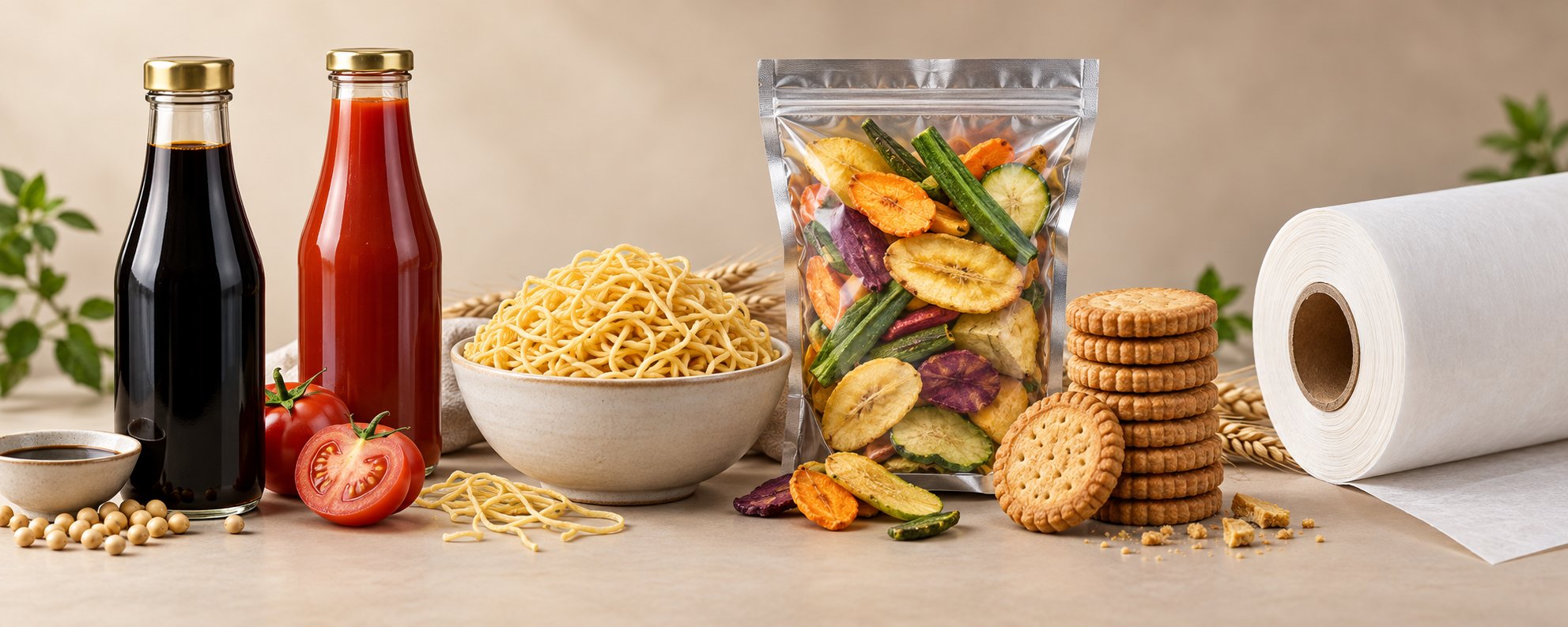
For buyers assembling a mixed basket, a supplier that also runs adjacent categories can reduce coordination cost. Xiamen Chenqi Imp. & Exp. Co., Ltd., for example, publishes an Instant Noodles product inside its own Noodle Food category, illustrating how one supplier catalog can combine discrete food lines under a single export relationship.
The Real Trade-offs Behind Low MOQ
Low MOQ is never free. Expect one or more of the following:
- Higher unit price: short runs spread setup, label printing, and retort loading across fewer cans.
- Longer lead time: small orders are often scheduled between larger productions.
- Narrower recipe flexibility: some factories reserve formulation changes for volume commitments.
- Packaging limits: unusual can sizes or premium lids may carry their own minimum.
- Sample-to-bulk variance: a hand sample may not match the bulk line exactly; confirm the bulk specification sheet.
A supplier that is transparent about these constraints is usually a better partner than one quoting an unrealistically low MOQ without qualification.
Verification Steps Before You Commit
- Ask for the MOQ in writing per SKU, per can size, and per label version.
- Request a bulk-production specification sheet, not only a sample photo.
- Confirm who owns the label artwork and whether files are reusable on repeat orders.
- Check that ingredient and allergen declarations match your destination market's labeling rules.
- Ask how seal integrity and shelf-life are handled on short runs.
- Clarify Incoterms, payment terms, and who handles export documentation.
- Run a paid trial order and inspect before scaling.
Choosing by Buyer Type
- New private-label brand: prioritize a trading company or mid-sized cannery accepting a small mixed trial; accept a higher unit price for flexibility.
- Established importer adding SKUs: use existing volume leverage to negotiate lower MOQ on new items with the same factory.
- Retail or foodservice chain: focus on documentation consistency and repeatability rather than the lowest first-order MOQ.
- Distributor testing a niche category: a single-category specialist often gives better technical support than a generalist.
FAQ
What is a realistic low MOQ for private label canned food from China?
It varies by product and packaging, but trial runs in the low hundreds to low thousands of units per SKU are commonly discussed. Always confirm for your specific can size and recipe.
Does low MOQ mean lower quality?
No. It usually means higher unit cost and tighter scheduling, not lower production standards. Verify with a bulk specification sheet and a paid trial order.
Can one supplier handle both OEM recipe changes and private label branding?
Often yes, but recipe changes may carry a higher minimum than label-only changes. Separate the two in your quotation request.
Action Checklist
Shortlist three to five canned food exporter candidates, request written per-SKU MOQ, compare the trade-offs above, and place one paid trial order before committing to a seasonal program. Treat every published MOQ, lead time, and capability as a starting point to be reconfirmed in writing.