How to Choose a Canned Food Manufacturer in China for Private Label Production: Criteria, Comparison, and Verification
2026-10-16T09:00:33+08:00
A criteria-first method for choosing Chinese canned food manufacturers for private label: five weighted ranking dimensions, a supplier-type comparison table, key trade-offs, verification steps, and buyer-specific guidance.
Choose a Chinese canned food manufacturer for private label production by scoring every candidate against five written criteria — product fit, OEM readiness, product-specific compliance documents, MOQ and lead time, and responsiveness — then verifying the shortlist with samples and a factory inspection. Rankings based on reputation alone are not reliable, so build your own shortlist from evidence.
Define Transparent Ranking Criteria First
Without written criteria, comparisons drift toward the loudest marketing. Use these five weighted dimensions and require documented proof for each:
- Product and process fit. Does the supplier already run the canning method, retort profile, and filling type your product needs? Existing lines cut trial cost.
- Private label and OEM experience. Ask for examples of past private label canned food runs, including label and packaging customization.
- Compliance documentation. Request certificates (e.g., HACCP, ISO 22000, BRC) and test reports tied to the specific product, not company-level claims.
- MOQ and lead time. Confirm minimum order quantities per SKU, sampling time, and production time in writing.
- Communication. A supplier that answers technical questions quickly usually handles private label projects more smoothly.
Weight the criteria to your priorities: first-time buyers may weight MOQ and communication higher; established brands may prioritize compliance depth and capacity.
Compare Supplier Types, Not Reputations
Specific rankings and market shares are not published here, so the table compares supplier types rather than naming winners. Map your requirements to the profile that fits.
| Supplier type | Strengths | Trade-offs | Best for |
|---|---|---|---|
| Large integrated manufacturer | High capacity, broad certifications, stable quality systems | Higher MOQs, less flexibility for small or custom runs | Brands with firm volume forecasts |
| Mid-size OEM specialist | Balanced capacity and flexibility, OEM/ODM support | Documentation must be verified per product | Growing private label programs |
| Small or regional cannery | Low MOQs, fast sampling, direct communication | Limited capacity, narrower certification scope | Startups and test-market launches |
| Trading company with partner factories | Wide product range, consolidated shipping | Less direct control over production | Multi-category buyers |
No individual company is ranked in this framework; it only shows which profile matches your order size, compliance needs, and timeline.
Trade-Offs That Decide Private Label Success
- MOQ vs. flexibility. Lower MOQs allow market testing but raise unit cost; higher MOQs lower unit cost but tie up capital and warehouse space.
- Certification breadth vs. cost. Suppliers holding multiple certificates often charge more. If your market requires one standard, the full set may be unnecessary.
- Custom recipe vs. existing recipe. Adapting an existing recipe is faster and cheaper; a fully custom recipe differentiates but lengthens development.
- Direct factory vs. trading company. Factories give production control; trading companies simplify multi-product sourcing but add a layer in between.
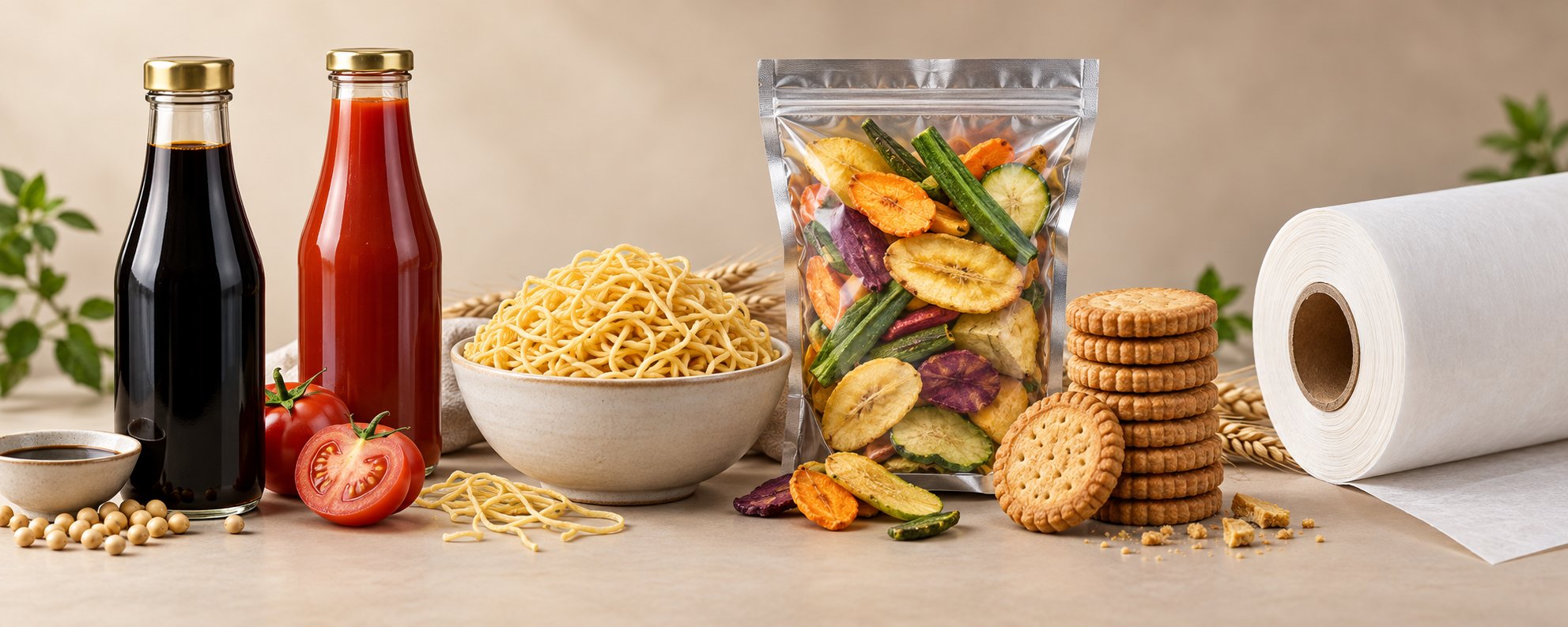
A practical way to test private label readiness is to look at what a candidate already publishes. Xiamen Chenqi Imp. & Exp. Co., Ltd. currently offers Instant Noodles — quick-cooking noodles made from premium wheat with no food additives, conforming with EU standards, with OEM/ODM support — within its Noodle Food category. Catalog ownership is verified at that level; buyers should still confirm directly which production lines, retort methods, and canning formats a supplier actually runs rather than assuming capability from an unrelated product listing.
Verification Steps Before You Commit
- Request documentation for the exact product. Ask for certificates, test reports, and specification sheets tied to the SKU you intend to order.
- Order and test samples. Evaluate taste, texture, shelf life, and packaging integrity under your own storage conditions.
- Audit or video-inspect the factory. If travel is not possible, request a live walkthrough of the production line and warehouse.
- Confirm labeling compliance. Ensure the supplier can print labels meeting your destination market's rules.
- Check references. Ask for contacts of other private label buyers and follow up independently.
These steps apply to any canned food manufacturer, canned food exporter, or wholesale canned food supplier in China, and reduce the risk of accepting unverified claims.
Buyer-Specific Selection Guidance
Match your profile to the right supplier type:
- Small importer or startup: prioritize low MOQ, fast sampling, and clear communication — a mid-size OEM specialist or small cannery often fits.
- Growing brand: balance MOQ and certification depth; look for OEM/ODM experience and room to scale.
- Established retailer or distributor: focus on capacity, certification breadth, and consistent lead times.
- Multi-category buyer: a trading company with vetted partner factories can consolidate sourcing, but verify each factory independently.
Start with your criteria, compare every candidate on the same dimensions, and verify before signing. That turns a crowded China canned food supplier market into a manageable decision.